Renewal Automation: The Complete Guide to Increasing Customer Retention and Recurring Revenue
What is Renewal Automation?
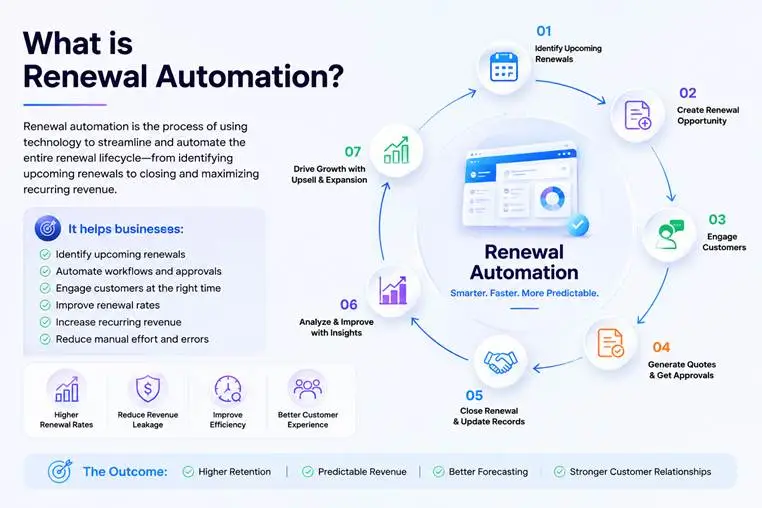
Renewal automation is the process of using software to automate recurring contract, subscription, warranty, maintenance, or service renewals. Instead of relying on manual spreadsheets, emails, and follow-ups, businesses use automated workflows to manage every stage of the renewal lifecycle.
A renewal automation platform identifies upcoming renewals, notifies the appropriate stakeholders, generates renewal opportunities, initiates approval workflows, prepares renewal quotes, sends customer communications, tracks progress, and provides real-time visibility into the renewal pipeline.
By automating repetitive tasks, organisations can reduce manual effort, improve collaboration across sales, customer success, finance, and operations teams, and ensure that renewal opportunities are handled proactively rather than reactively.
Renewal automation is commonly used for:
- SaaS subscriptions
- Software licences
- Hardware maintenance contracts
- Technology support agreements
- Managed services
- Cloud subscriptions
- Service-level agreements (SLAs)
- Warranty renewals
- Enterprise service contracts
Rather than waiting until a contract expires, renewal automation helps businesses engage customers well in advance, reducing the risk of missed renewals and improving customer retention.
How Renewal Automation Works
A typical renewal automation process follows these steps:
- The platform identifies contracts approaching their renewal date.
- Renewal opportunities are automatically created.
- Sales, customer success, or channel partners are assigned based on predefined rules.
- Customer communication begins with automated reminders and notifications.
- Renewal quotes are generated using pricing and contract data.
- Internal approval workflows are triggered when needed.
- Customer interactions are tracked across email, CRM, and other systems.
- Once the renewal is completed, dashboards update automatically and the next renewal cycle begins.
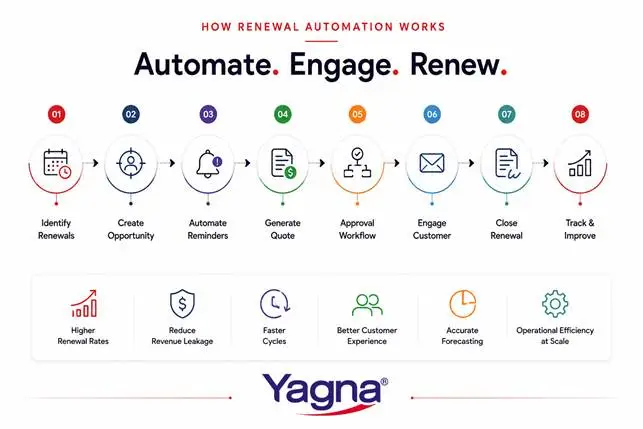
Instead of managing dozens of disconnected tasks manually, renewal automation creates a standardized, repeatable process that reduces delays and improves consistency.
Why Renewal Automation Matters
Many organizations focus heavily on acquiring new customers but overlook the value of retaining existing ones.
For businesses with recurring revenue models, renewals represent one of the most predictable and cost-effective sources of growth.
Without automation, renewal teams often face challenges such as:
- Missed renewal dates
- Manual data entry
- Inconsistent customer communication
- Poor visibility into renewal pipelines
- Delayed approvals
- Revenue leakage
- Limited forecasting accuracy
These inefficiencies not only reduce operational productivity but can also negatively impact customer satisfaction and long-term business growth.
Renewal automation addresses these challenges by ensuring that every renewal opportunity is tracked, prioritized, and managed through a structured workflow.
By replacing manual processes with automation, organizations gain greater control over their renewal pipeline, improve forecasting, and create a more consistent customer experience.
Why Enterprise Businesses Need Renewal Automation
Enterprise organizations often manage thousands of customers, contracts, products, pricing models, distributors, and sales teams. As this complexity grows, manual renewal processes become increasingly difficult to scale.
Renewal automation helps enterprise businesses:
- Standardize renewal workflows across regions and teams
- Reduce operational overhead
- Improve collaboration between sales, finance, and customer success
- Increase renewal rates
- Improve forecasting accuracy
- Minimize revenue leakage
- Deliver a consistent customer experience
- Scale recurring revenue operations efficiently
For enterprises operating through channel partners, distributors, or resellers, automation also improves coordination across multiple stakeholders, ensuring that renewal opportunities are not lost due to communication gaps.
Benefits of Renewal Automation
For businesses that rely on recurring revenue, renewals are more than an administrative task—they're a critical driver of long-term growth. Yet many organizations still manage renewals using spreadsheets, email reminders, or disconnected systems, creating unnecessary risk and inefficiency.
Renewal automation transforms this process by replacing manual work with intelligent, repeatable workflows. The result is a more predictable renewal process, stronger customer relationships, and improved business performance.
Here are the key benefits of renewal automation.
-
The most significant benefit of renewal automation is improving renewal rates.
Many customers don't churn because they're dissatisfied—they churn because the renewal process is inconsistent. Delayed follow-ups, missed reminders, and poor communication can cause customers to overlook or postpone renewals.
Renewal automation ensures that every customer receives timely notifications, personalized renewal communications, and proactive engagement before their contract expires. By standardizing the renewal process, businesses can reduce missed opportunities and create a smoother customer experience.
-
Revenue leakage occurs when renewal opportunities are missed, delayed, or incorrectly processed.
Even small operational gaps can lead to significant revenue loss over time, particularly for enterprises managing thousands of contracts.
Renewal automation helps prevent revenue leakage by:
- Identifying contracts approaching expiration
- Automatically creating renewal opportunities
- Sending reminders to internal teams
- Escalating overdue renewals
- Tracking every renewal through completion
With greater visibility into the renewal pipeline, businesses can ensure that valuable recurring revenue isn't lost due to avoidable operational issues.
-
Managing renewals manually requires sales representatives, customer success teams, finance, and operations to perform repetitive tasks every day.
These tasks often include:
- Tracking renewal dates
- Sending reminder emails
- Creating renewal quotes
- Requesting approvals
- Updating CRM records
- Following up with customers
- Coordinating between departments
Renewal automation eliminates much of this manual work by automating routine activities, allowing teams to focus on customer engagement and strategic initiatives instead of administrative tasks.
-
Customers expect proactive, timely, and consistent communication throughout their relationship with a business.
A delayed renewal reminder or inaccurate renewal quote can create frustration and negatively impact customer satisfaction.
Renewal automation helps deliver a seamless customer experience by ensuring:
- Timely renewal reminders
- Personalized communications
- Accurate pricing
- Faster quote delivery
- Clear renewal status updates
- Consistent interactions across channels
A well-managed renewal process reinforces trust and encourages long-term customer loyalty.
-
Revenue forecasting becomes difficult when renewal opportunities are tracked manually.
Without real-time visibility, leadership teams often struggle to answer questions such as:
- How many renewals are due this month?
- What is the projected renewal revenue?
- Which high-value accounts are at risk?
- Where are deals getting delayed?
Renewal automation centralizes renewal data into dashboards and reports, giving leaders accurate insights into the health of their recurring revenue pipeline.
This enables better financial planning, resource allocation, and executive decision-making.
-
Sales, customer success, finance, and operations teams often spend hours each week on repetitive renewal activities.
Automation reduces administrative work by:
- Automatically assigning renewal owners
- Triggering approval workflows
- Generating renewal opportunities
- Updating CRM records
- Scheduling customer communications
As a result, employees spend less time managing processes and more time engaging customers and driving business growth.
-
Renewals often require coordination between multiple departments.
For example:
- Sales negotiates pricing.
- Customer Success manages relationships.
- Finance verifies contracts.
- Operations confirm service details.
- Legal reviews agreements.
Without a centralized workflow, important information can become fragmented across emails, spreadsheets, and different business systems.
Renewal automation creates a single, shared workflow where every stakeholder has visibility into renewal progress, responsibilities, and next steps.
-
As organizations grow, different teams often develop different renewal processes.
This inconsistency can lead to:
- Missed deadlines
- Duplicate work
- Inconsistent customer experiences
- Reporting challenges
- Compliance risks
Renewal automation standardizes workflows by ensuring every renewal follows predefined business rules, approval processes, and communication schedules.
Standardization improves efficiency while maintaining consistency across regions, business units, and customer segments.
-
Business growth usually means more customers, more contracts, and more renewals.
Without automation, organizations often need to hire additional staff simply to keep up with increasing workload.
Renewal automation allows businesses to manage a larger volume of renewals using the same operational resources by automating repetitive tasks and streamlining workflows.
This improves operational scalability while helping control costs.
-
A renewal conversation is one of the best times to introduce additional products or services.
By providing account insights, contract history, and customer usage information, renewal automation helps sales teams identify opportunities to:
- Upgrade licences
- Expand product adoption
- Add new services
- Increase contract value
- Extend contract duration
This transforms renewals from a retention activity into a revenue growth opportunity.
How to Choose the Right Renewal Automation Solution
Selecting the right renewal automation platform is a strategic decision that can significantly impact customer retention, operational efficiency, and recurring revenue. While many solutions offer automation capabilities, not all are designed to support enterprise-scale renewal operations.
Here are the key factors to consider when evaluating a renewal automation solution.
-
Choose a platform that automates the complete renewal lifecycle—from identifying upcoming renewals and generating opportunities to approvals, customer communication, and reporting—rather than automating only individual tasks.
-
Look for solutions that leverage AI to identify renewal risks, prioritize opportunities, recommend next actions, and improve forecasting accuracy. AI-driven insights help teams make proactive decisions rather than reacting to missed renewals.
-
Your renewal automation platform should integrate seamlessly with your existing business systems, including:
- CRM platforms
- ERP systems
- CPQ solutions
- Billing platforms
- Customer Success platforms
- Email and collaboration tools
Integrated data ensures a single source of truth and eliminates manual data entry.
-
As your business grows, your renewal platform should be able to manage increasing contract volumes, multiple business units, regional operations, and complex approval workflows without compromising performance.
-
Every organisation has unique renewal processes. Look for a solution that allows you to configure workflows, approval rules, notifications, task assignments, and business logic to match your operational requirements.
-
Comprehensive dashboards provide visibility into renewal pipelines, renewal rates, forecasted revenue, at-risk accounts, and team performance. These insights support better decision-making and executive reporting.
-
Enterprise businesses should ensure the platform meets industry security standards and provides audit trails, role-based access controls, and compliance support to protect sensitive customer and contract data.
-
Consider vendors with proven experience in recurring revenue management, enterprise automation, and your specific industry. Industry expertise often leads to faster implementation and better long-term.